


Understanding Organizational Structure in SAP S/4HANA Procurement [SAP MM]
- Vivek
- Jan 21
- 4 min read
Updated: Feb 5
When working with SAP S/4HANA Procurement, one of the first and most important concepts to understand is the organizational structure. Before any purchase requisition is created or any purchase order is issued, SAP needs to know who is buying, for which legal entity, and under what control framework. This is exactly what the organizational structure defines. It represents how a company is legally, financially, and operationally arranged within the SAP system.
Understanding the organizational structure in SAP S/4HANA Procurement is essential for consultants, business users, and decision-makers, as it directly impacts reporting, authorization, vendor management, and financial integration.
Key Organizational Elements in SAP S/4HANA Procurement
1. Client – The Top-Level Entity
The Client is the highest organizational level in SAP. Specifications or data that you make and enter at this level apply to all company codes and other organizational units.
All company codes, plants, and purchasing organizations exist within a single client.
Access authorization is assigned on a client-specific basis. A distinct user master record must be created for each user in each client.
A client is uniquely defined in the system by a three-digit numeric key. [100,200,300]

2. Company Code – Legal and Financial Identity
The Company Code represents a legal entity for which statutory financial statements are prepared. Whenever a vendor invoice is posted or a goods receipt is valuated, the financial impact is recorded at the company code level. This is why procurement and finance are tightly linked through the company code.
Each company code has its own balance sheet and profit & loss statement
Procurement postings like GR/IR and vendor invoices are financially recorded at this level
One or more plants can belong to same company code
Company code is created as a four digit Alpha-numeric key, which is unique in each client.

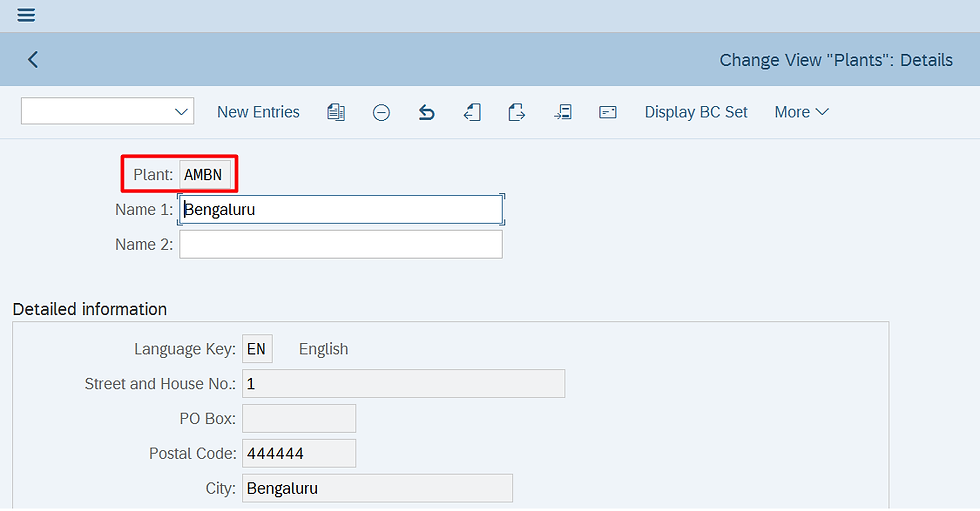
3. Plant – Where Procurement Meets Operations
The Plant is one of the most important organizational units in procurement. It can represent physical location such as a factory, warehouse, or a service location. Or, Plant is a operational unit where goods are produced, stored, or delivered.
Purchase requisitions and goods receipts are plant-specific
Inventory management is handled at plant level
Valuation of materials is typically maintained at plant level (material ledger is mandatory in S/4HANA)
Plant is created as a four digit Alpha-numeric key, which is unique in each client.
4. Storage Location – Physical Stock Management
A Storage Location is a subdivision of a plant and represents where materials are physically stored. we can create multiple storage location under each plant.
While procurement decisions are not taken at storage location level, it plays a critical role in inventory visibility. Goods receipts, stock transfers, and issues are all tracked at this level.
Used for inventory tracking and stock management
Helps in managing warehouse operations
Relevant for goods receipt, goods issue, and stock transfers

5. Purchasing Organization – The Core of Procurement Control
The Purchasing Organization is the unit that is actually responsible for buying materials and services.
Key responsibilities include:
Vendor negotiation and pricing
Contract and scheduling agreement management
Purchase order processing
Types of purchasing organizations:
Plant-specific – Procures only for one plant
Company code-specific – Procures for all plants under one company code
Central purchasing organization – Procures for multiple company codes
If a purchasing organization is to operate across company codes (decentralized, strategic purchasing), there is no assignment between company codes and purchasing organizations.
In this case, plants from all company codes can be used for the “purchasing organization to plant” assignment.
However, if a purchasing organization is assigned to a company code, only plants from the selected company code can be used for the “purchasing organization to plant” assignment.
SAP S/4HANA strongly supports centralized procurement, allowing organizations to standardize purchasing while still serving multiple business units.

6. Purchasing Group – The People Behind Procurement
The Purchasing Group represents the buyers or teams who perform day-to-day purchasing activities.
Defined as a key in purchasing documents
Used for reporting and workload distribution
Helps in assigning accountability to individual buyers or teams
Unlike other organizational units, the purchasing group is not assigned to any specific organizational level (company code or plant), giving flexibility in operations.

.
How Organizational Structure Impacts Procurement Processes
A well-designed organizational structure ensures:
Clear responsibility for purchasing decisions
Accurate financial postings during goods receipt and invoice verification
Effective authorization control using roles and approvals
Consistent reporting across procurement and finance
Scalability to support business growth and central procurement
Incorrect or poorly designed structures often lead to process inefficiencies, posting errors, and reporting challenges.

Organizational Structure in SAP MM ECC v/s S/4HANA Procurement
While the basic organizational elements remain similar to SAP ECC, SAP S/4HANA introduces tighter integration and simplified data models.
Key improvements include:
Real-time financial integration via Universal Journal
Mandatory material ledger for accurate valuation
Enhanced support for central procurement
Faster and more transparent reporting
Because of these changes, organizational structure design in S/4HANA requires more careful planning than in ECC.
Conclusion
Organizational structure is the backbone of SAP S/4HANA Procurement. It defines how procurement interacts with finance, inventory, and business operations. A clear and well-thought-out structure ensures control, transparency, and efficiency across the purchasing process.
Whether you are implementing SAP S/4HANA or optimizing an existing system, investing time in understanding and designing the right organizational structure will significantly improve procurement outcomes and user experience.

![Difference Between SAP ECC MM and SAP S/4HANA Procurement [SAP MM ECC v/s S/4HANA]](https://static.wixstatic.com/media/94eda5_c216c11776674904b6c3504ffe88b7cf~mv2.png/v1/fill/w_980,h_653,al_c,q_90,usm_0.66_1.00_0.01,enc_avif,quality_auto/94eda5_c216c11776674904b6c3504ffe88b7cf~mv2.png)
![What Is SAP S/4HANA Procurement? A Beginner’s Overview [SAP MM]](https://static.wixstatic.com/media/94eda5_130121e7a1d34c35851ecf5e824c7228~mv2.png/v1/fill/w_980,h_653,al_c,q_90,usm_0.66_1.00_0.01,enc_avif,quality_auto/94eda5_130121e7a1d34c35851ecf5e824c7228~mv2.png)


This piece offered a genuinely fresh way of looking at a subject I thought I already understood fairly well. The author's explanations opened up angles I hadn't considered before reading through this properly. That freshness made the whole piece feel like a real discovery rather than familiar, repeated ground. If this resonated with you, discover helpful content covering similar themes nearby. Thanks for such a genuinely fresh and thought-provoking piece.
This piece answered my initial question clearly, but it also left me with a genuine sense that there's more to explore on this specific subject. The author hinted at related complications without fully unpacking them, which struck me as a deliberate choice rather than an oversight. That restraint made me want to keep digging rather than assuming I now had the complete picture. I appreciated that the piece didn't pretend to be the final word on a topic that's clearly still evolving in some respects. It's the kind of writing that treats a subject as an ongoing conversation rather than something fully settled and closed off. There's genuinely more to explore here, and I'm glad the piece pointed me in…
This blog post came at just the right time, since I've been trying to learn more about this exact topic lately. The structure made everything easy to digest, even when the content got more technical toward the middle. I liked that you included real examples rather than just relying on theory. It made the whole piece feel practical instead of abstract. I'll definitely be referring back to this blog post whenever the subject comes up again. Great work on this one.
Finding a good online identity is harder than it sounds. This name generator helped me discover several names that were both memorable and easy to use across different platforms.
I keep a tab open with crazygames for when I need a break during work. They have a decent collection of browser games that run smoothly without any lag. The racing and shooting categories are where I usually end up spending most of my time.